
Driving for rideshare platforms like Uber or Lyft in Florida offers great earnings potential, but the Sunshine State maintains distinct insurance laws that every gig driver must navigate. Under Florida Statute § 627.748 (the Transportation Network Company Act), rideshare drivers and platforms must maintain strict minimum financial responsibility limits based on active app status.
Because Florida is a No-Fault insurance state utilizing Personal Injury Protection (PIP), understanding how rideshare insurance interacts with state personal auto coverage is vital to prevent denied claims after an accident.
In this article, we break down Florida’s legal minimum rideshare insurance requirements, phase-by-phase coverage requirements, and how to stay fully compliant.
Florida Rideshare Insurance Coverage Limits by Driving Phase
Florida law categorizes rideshare driving into three distinct operational phases, each enforcing different minimum insurance standards:
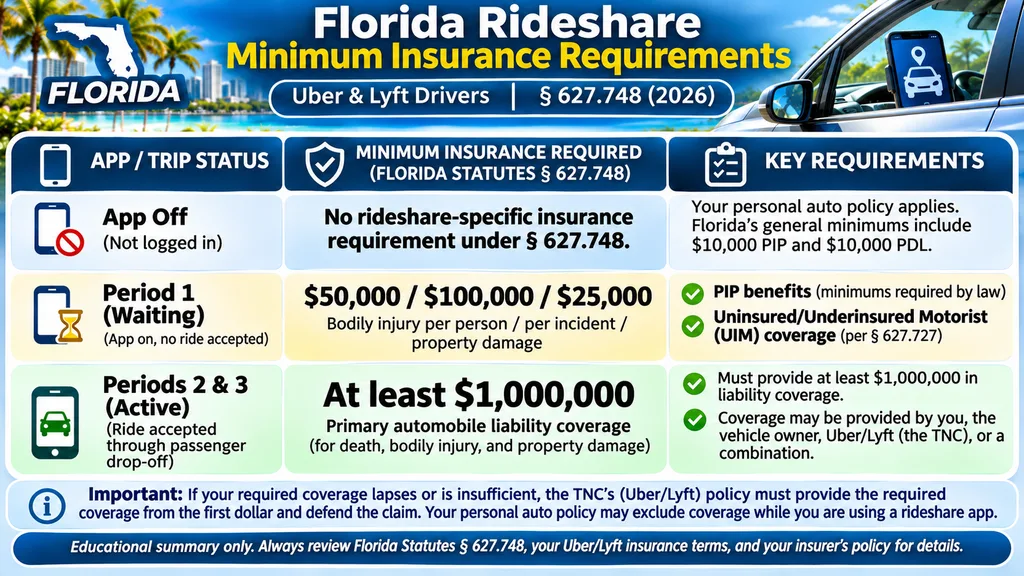
1. App OFF (Personal Driving)
When your Uber or Lyft app is completely turned off, you are bound only by Florida’s standard personal auto insurance minimums:
- $10,000 Personal Injury Protection (PIP)
- $10,000 Property Damage Liability (PDL)
2. Period 1: App ON, Waiting for a Ride Request
The moment you log into the rideshare app and make yourself available to accept rides, Florida law enforces higher primary liability limits:
- $50,000 for death and bodily injury per person.
- $100,000 for total death and bodily injury per accident.
- $25,000 for property damage liability.
- Mandatory PIP and Uninsured Motorist (UM) coverage as required under Florida insurance codes.
The Coverage Gap: While Uber or Lyft provides contingent liability for Period 1 in Florida, they do not cover physical damage (collision/comprehensive) to your vehicle during this phase unless you hold a personal policy with a rideshare endorsement.
3. Period 2 & 3: Match Accepted to Passenger Drop-off
From the second you accept a ride request (Period 2) through transporting passengers to their destination (Period 3), Florida law mandates primary liability coverage of at least $1,000,000 Combined Single Limit for death, bodily injury, and property damage.
How Personal Injury Protection (PIP) Works for Florida Rideshare Drivers
Florida’s No-Fault insurance system requires drivers to carry $10,000 in Personal Injury Protection (PIP) to cover initial medical bills and lost wages regardless of fault in a crash.
- Personal Policy Exclusion: Your personal auto PIP policy will exclude injuries sustained during commercial rideshare driving.
- TNC Responsibility: Under Florida Statute § 627.748, the rideshare company’s policy must provide primary PIP benefits during active driving periods if your personal policy excludes commercial use.
Do You Need a Personal Rideshare Endorsement in Florida?
Yes. Relying solely on Uber or Lyft’s state-mandated minimum coverage leaves major vulnerabilities:
- Protecting Your Personal Vehicle: A personal rideshare endorsement bridges Period 1 physical damage gaps so repairs to your vehicle are covered.
- Preventing Policy Non-Renewal: Declaring your rideshare status prevents your personal insurance carrier from canceling your policy for material misrepresentation.
- Absorbing High Deductibles: Uber and Lyft impose a $2,500 physical damage deductible. Many Florida rideshare endorsements help cover the difference down to your personal deductible limit.
Frequently Asked Questions (FAQ)
Is rideshare insurance required by law for drivers in Florida?
Florida law requires that specified liability limits ($50k/$100k/$25k in Period 1 and $1M in Periods 2 & 3) be active while driving for a TNC. While TNCs provide basic coverage, carrying a personal rideshare endorsement is necessary to protect your own vehicle and personal policy.
What happens if my personal insurer finds out I drive Uber in Florida?
If you haven’t declared your gig work, your personal insurer can reject any claims occurring during app usage and may issue an immediate non-renewal notice.
How much does a rideshare endorsement cost per month in Florida?
In Florida, adding a rideshare endorsement to an existing personal auto policy generally costs between $15 and $40 per month, depending on your carrier and location (e.g., Miami vs. Orlando rates).
Summary & Action Checklist for Florida Drivers
To remain 100% compliant and financially secure while driving rideshare in Florida:
- Verify that your personal insurer offers a Florida rideshare endorsement.
- Confirm that your policy maintains comprehensive and collision coverage to unlock platform contingent physical damage protection.
- Keep digital and physical copies of your insurance card and TNC certificates in your vehicle.